Nine Quiet Courtesies: Driveway Valeting Manners for Shared Streets
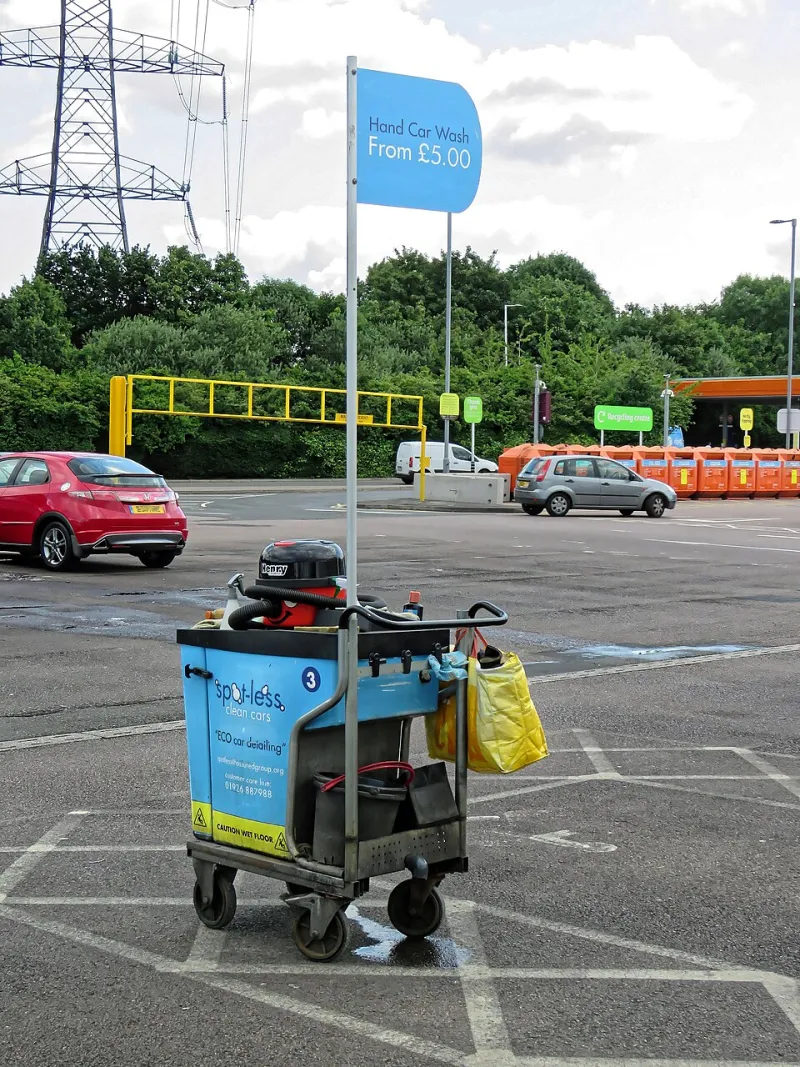
Photo: Acabashi, CC BY-SA 4.0, via Wikimedia Commons
Driveway valeting is usually described as a service. On a shared drive in a suburban cul-de-sac or a terraced street in an old mill town, it is closer to a small piece of street theatre: a van, a hose, a swirl of foam and a neighbour pretending not to watch from behind the net curtains. That audience is the reason etiquette matters. Twenty years of washing cars in other people's front gardens has convinced us that the difference between a welcome visitor and a nuisance is almost never the quality of the finish. It is a handful of small decisions made before the first drop of water lands.
What follows is opinion, offered plainly. None of it is law, and all of it is common sense that is surprisingly often forgotten.
1. Say what is happening before the hose comes out
A knock at the door takes fifteen seconds and prevents an afternoon of resentment. Tell the neighbour whose car sits closest that you will be working for an hour or two, that water may run across the shared apron, and roughly when you expect to finish. The same applies to the householder: if a valet is attending, a word to next door about a van on the drive is simple courtesy, and it stops a parking dispute before it begins.
2. Decide where the water goes — deliberately
Runoff is the single most common source of friction on a shared drive. Water carrying shampoo and wax residue should not be sent across a neighbour's block paving, into their garage threshold or over a boundary. Trade bodies and many local authorities advise that wash water containing detergent belongs in the foul drainage system rather than a surface water drain or a soakaway, and a professional outfit should know where the falls on your drive take the water before it starts work. If the only route is past someone's front door, that is a conversation to have first.
3. Keep the noise inside civilised hours
Pressure washers carry. On a quiet Sunday morning, a lance at full chat travels the length of a terrace and into every back bedroom. Early starts should be reserved for detached properties or agreed in advance; on shared ground, mid-morning onwards is the polite window, and a firm finish time in the early evening protects everyone's patience.
4. Do not annex the shared bay
A communal parking area is not a workshop. If the vehicle must be moved to reach the far side, agree it with whoever owns the adjacent space rather than assuming. Keep the turning circle clear, leave room for a neighbour returning from a shift, and never block a garage that might be needed without warning. A valet who needs twenty minutes of exclusivity should ask for twenty minutes of exclusivity.
5. Ask before you borrow a tap
Outside taps are generously shared and quietly resented. A mobile service should arrive self-sufficient with its own water supply; where a household supply is genuinely needed, ask the householder directly, offer to cover the cost, and never run a hose through a gate that belongs to somebody else.
6. Watch the wind, not just the car
Overspray is invisible until it dries on next door's freshly cleaned hatchback, their uPVC windows or their bedding plants. Check the direction of the breeze before applying anything that foams, and move the vehicle if the drift is towards a neighbour's property. A short walk around the car before starting is cheaper than an apology afterwards.
7. Keep the footpath passable
Hoses across a pavement are a trip hazard for anyone with a buggy, a walking stick or a delivery trolley. Where a hose must cross a public footpath, it should be routed at the earliest and latest opportunity, marked if it will stay for any length of time, and never left unattended across the kerb.
8. Give other people's paint two metres of respect
Tight drives are where good intentions scratch cars. Buckets set down on a neighbouring bonnet, a lance swung too widely, a door opened against the car alongside — all of it happens in the last five minutes when attention is elsewhere. Keep kit on the ground sheet, open doors by hand rather than momentum, and leave working space between your vehicle and the next. On a narrow shared drive, ask the neighbour to move their car if the alternative is working at arm's length from their paint.
9. Leave the space better than you found it
Rinse the shared apron. Sweep up the stray microfibre tag, the empty bottle cap, the leaf mulch that came off the sills. Do not leave a soapy tide mark drying across next door's threshold. A driveway that looks untouched apart from the car is the mark of a service that understands it is a guest.
Why this is more than politeness
There is a commercial argument buried in all of this. Mobile valeting works because it removes the friction of the forecourt: no queue, no waiting room, no Saturday lost. But that convenience only holds if the visit does not create friction of a different kind at home. A service that has to be explained to a neighbour, or apologised for, is not convenient at all.
So treat the street as the customer's second living room. Announce yourself, control the water, mind the clock and leave nothing behind but a clean car. That is not old-fashioned fussiness. It is the practical foundation on which driveway valeting earns its place in a UK neighbourhood.