Seeing the Road Home: A Headlamp Clarity Audit for Britain's Early Dusk
There is a particular moment in the British autumn when the afternoon simply gives up. The school run finishes under street lighting, the motorway begins to look like a corridor of oncoming glare, and the four o'clock headlight becomes a daily fixture rather than an occasional courtesy. In that setting, a pair of clouded headlamp lenses stops being a cosmetic blemish and starts to feel like a limitation on how far ahead you can comfortably see.
At Empire Valeting Services, we are asked about hazy lamps more often between October and January than at any other point in the year. The question is nearly always the same: can this be restored on the driveway, or is it a job for a bodyshop? The honest answer depends on which part of the lamp has deteriorated, and that determination is worth making carefully before any abrasive touches the lens.
Why clarity matters beyond appearance
A headlamp is an optical instrument, not merely a window. The lens is shaped to bend and focus light into a beam with a defined cut-off, so that the road ahead is lit without dazzling others. Oxidation roughens the outer surface, scattering light in directions the reflector never intended. The result is a beam that looks bright from the driver's seat but delivers less usable light on the tarmac, while oncoming traffic receives more glare than it should.
Beyond comfort, there is the matter of inspection. A deteriorated lens can affect the way beam aim is assessed, and a tester may record an advisory where the pattern is visibly poor. Add the practical reality of darker commutes, wet surfaces that swallow light, and the growing number of unlit rural lanes on weekend errands, and the case for attention becomes straightforward.
Reading the lens: surface versus structure
Before reaching for a polisher, establish what has actually failed. Work in daylight with the lamp switched on, then repeat the inspection with a torch at a shallow angle.
Signs of surface oxidation
- A uniform yellow or chalky cast across the whole lens, most pronounced at the top where sunlight falls.
- A slightly rough or gritty feel under a clean fingertip.
- Water that sits in flat patches rather than beading after a rinse.
- Clarity that improves noticeably when a small area is hand-rubbed with a mild compound.
This is the outer polycarbonate breaking down under ultraviolet light, road salt and wash chemicals. It is the case a driveway valet can genuinely improve.
Signs of internal degradation
- A milky or grey haze that remains after the outer surface has been cleaned and lightly polished.
- A sharp boundary between clear and cloudy areas, often following the edge of the reflector or projector bowl.
- Fine crazing, resembling a cracked glaze, that does not polish out.
- Droplets or a persistent film of moisture on the inside face of the lens.
- A browned or dulled reflector visible through the housing, or a cloudy projector bowl behind a clear lens.
A simple test settles most doubts. Clean the lamp, dry it, then polish a fifty-pence-sized patch by hand with a finishing compound. If that patch is visibly clearer than its surroundings, the problem is on the outside. If it looks no different, the damage sits within the lamp and no amount of rubbing will recover it.
Brief misting on a cold, damp morning is normal in modern vented housings and usually clears within minutes of the lamp warming. Standing droplets, a permanent film, or water that sloshes audibly point to a failed seal, which is a replacement or reseal conversation rather than a polishing one.
A measured hand-polishing routine
The objective is to remove only the degraded layer, not to reshape the lens. Polishing removes material, and every pass takes a little of the lens's original UV protection with it. Restraint is the professional habit here.
- Wash and dry first. Grit trapped at the lens edge will travel under the pad. A thorough clean, including the surrounding panel gaps, prevents a careless scratch.
- Mask the paint. Low-tack tape around the lamp aperture protects bumper edges and wing tops from splatter and accidental contact with the machine.
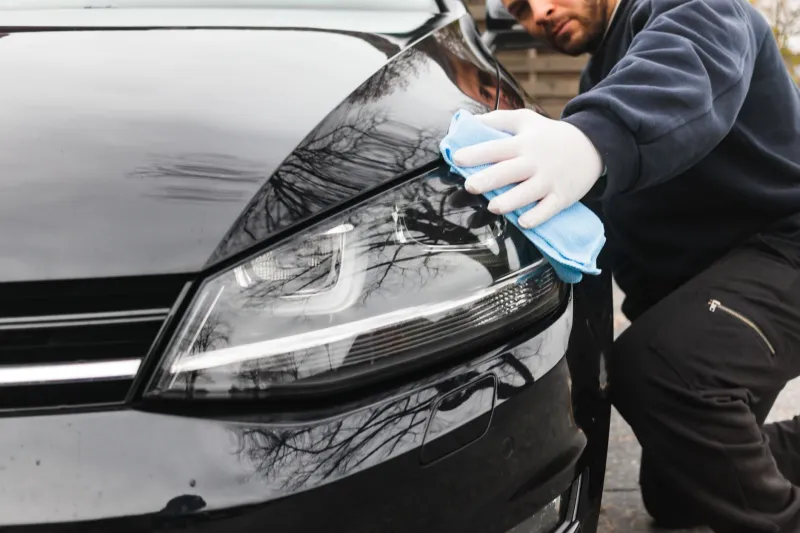
- Start mild. A soft foam pad with a medium-cut compound on a dual-action machine at moderate speed will resolve light oxidation in two or three passes. By hand, use a microfibre applicator and firm, even pressure.
- Work cool. Keep the pad moving and stop if the lens becomes uncomfortably warm. Heat is the enemy of polycarbonate.
- Refine. Follow with a finishing polish to remove compounding marks, then wipe down with a panel wipe to remove residue.
- Seal the result. A UV-stable sealant, applied thinly and buffed, will slow the return of yellowing. A specialist headlamp film offers more durable protection on cars kept outdoors. Reapply the sealant quarterly.
Wet sanding has its place on heavier oxidation, but it should be a considered step rather than a default one. Factory-applied hard coats on some vehicles do not tolerate abrasion well, and a lens that has been sanded too aggressively will haze again faster than before. Where a coating is clearly present and only lightly marked, a gentle polish and seal is the better wager.
When polish becomes a false economy
Repeated restoration of a lamp that keeps clouding is time spent without progress. Replacement deserves serious thought where the reflector has dulled, where moisture returns after sealing, where crazing runs deep into the material, or where the beam pattern is visibly ragged even after the lens is clear.
Cost should be weighed honestly. Aftermarket lamp units vary considerably in optical quality and fit, and a cheap pair can deliver a worse beam than a well-restored original. Where one lamp has failed internally and its partner is original and clear, replacing in pairs keeps the appearance and output consistent. Fitting is followed by beam aim adjustment, which is not a driveway task without the right equipment and a level surface.
A habit for the darker months
Add a lamp check to the routine you already keep. At each wash, look along the lens at a low angle, wipe the top edge where grime collects, and note any change in the beam against a garage door or wall. Clear lenses, correct aim and clean glass work together; there is little point in restoring a lamp if the windscreen wipers are smearing the view it provides.
On a dark November evening, the difference between a hazed lamp and a clear one is measured in metres of usable road and a noticeable reduction in eye strain. Where the deterioration is on the surface, a careful driveway session is one of the more satisfying improvements available. Where it is not, recognising the limit of polishing is the mark of a job done properly — and of a driver who would rather spend once than polish four times.